
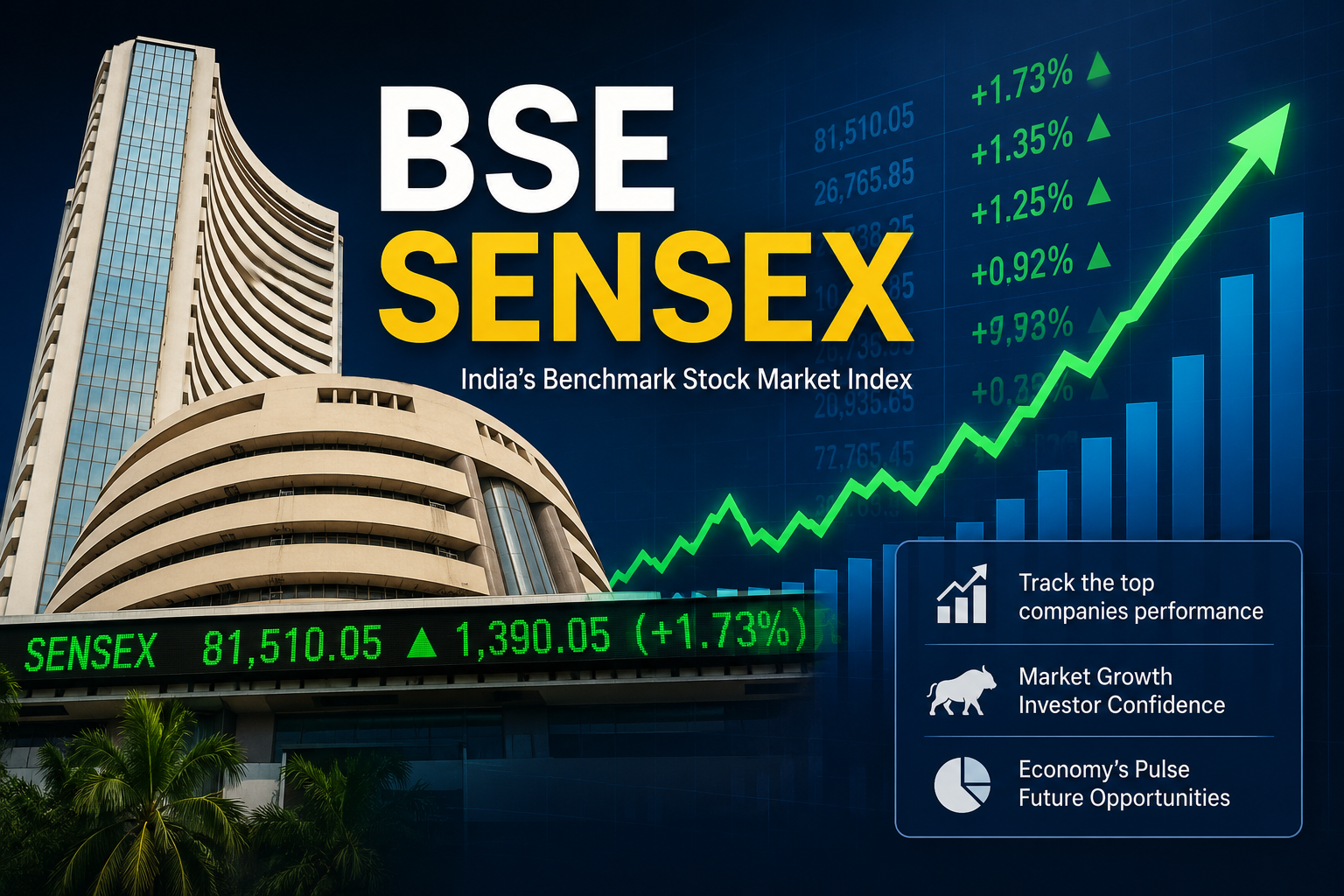
The BSE Sensex is one of the most recognized stock market indices in the world and the benchmark of the Indian stock market. Whether you are a beginner trying to understand investing or an experienced trader tracking market performance, the BSE Sensex plays a crucial role in measuring the health of India’s economy.
For decades, investors have relied on the BSE Sensex to evaluate market trends, identify investment opportunities, and understand investor sentiment. Since it consists of India’s leading companies, its movements often reflect the overall direction of the country’s financial markets.
In this comprehensive guide, you’ll learn everything about the BSE , including how it works, why it matters, how it’s calculated, what influences its movement, and why millions of investors monitor it every trading day.
What Is the BSE Sensex?
The BSE Sensex is the benchmark stock market index of the Bombay Stock Exchange (BSE), India’s oldest stock exchange. The word “Sensex” combines the words “Sensitive” and “Index,” highlighting its role as a sensitive indicator of stock market performance.
The index tracks the performance of 30 financially strong and well-established companies listed on the Bombay Stock Exchange. These companies represent different sectors of the Indian economy, including banking, technology, healthcare, energy, automobiles, consumer goods, and finance.
Because these companies are industry leaders, the BSE Sensex is considered one of the most accurate indicators of the Indian stock market’s overall performance. Investors, analysts, fund managers, and economists frequently refer to it when discussing market conditions.
History of the BSE Sensex
The history of the BSE Sensex dates back to 1986 when the Bombay Stock Exchange officially introduced the index. Since then, it has become India’s most widely followed stock market benchmark.
Initially, the purpose of the BSE was to provide investors with a reliable measure of market performance. Over time, it evolved into an essential tool for comparing investment returns and analyzing market trends.
The index has witnessed numerous historic events, including economic reforms, global financial crises, technological revolutions, pandemics, and major policy changes. Despite market volatility, the BSE Sensex has consistently reflected India’s long-term economic growth.
How the BSE Sensex Is Calculated
The BSE Sensex uses the Free Float Market Capitalization Method for calculation. This approach considers only the shares that are available for public trading rather than the total shares issued by a company.
Each company’s weight in the index depends on its free-float market capitalization. Larger companies have a greater influence on the movement of the BSE than smaller companies.
This calculation method ensures that the index accurately reflects actual market activity. As companies grow or shrink in market value, their contribution to the BSE automatically changes, keeping the index relevant and up to date.
Companies Included in the BSE Sensex
Only the most established companies qualify for inclusion in the BSE . Selection depends on various factors such as market capitalization, liquidity, financial stability, trading frequency, and sector representation.
The index includes companies from diverse industries, making it a balanced reflection of the Indian economy. Banking and financial services generally occupy a significant portion of the index because of their importance in India’s economic growth.
The list of companies is periodically reviewed to ensure that the BSE continues to represent the strongest and most actively traded businesses in the country.
Why the BSE Sensex Matters to Investors
The BSE Sensex serves as an essential investment benchmark for both domestic and international investors. It provides a quick snapshot of overall market performance without requiring investors to analyze thousands of individual stocks.
Many mutual funds and exchange-traded funds (ETFs) compare their performance against the BSE . If a fund consistently outperforms the index, it is generally considered to be delivering strong returns.
The BSE Sensex also influences investor confidence. Rising markets often encourage investment, while declining markets may lead investors to become more cautious about risk.
Factors That Influence the BSE Sensex
Many economic and global factors affect the movement of the BSE Sensex every day. Corporate earnings reports are among the most important influences because investors closely monitor company profitability.
Government policies, taxation changes, interest rates, inflation, and economic reforms can significantly impact market performance. Positive policy announcements often boost investor confidence, while uncertainty can create market volatility.
Global events also play a major role. International economic conditions, geopolitical tensions, crude oil prices, currency fluctuations, and decisions by major central banks frequently affect investor sentiment and influence the BSE .
Benefits of Tracking the BSE Sensex
Monitoring the BSE helps investors understand market trends and make better investment decisions. Instead of relying solely on individual stock movements, investors can evaluate the broader market direction.
The index provides valuable information about investor confidence. A steadily rising BSE Sensex generally indicates optimism regarding economic growth and corporate profitability.
Tracking the BSE Sensex also helps long-term investors stay focused on market trends rather than reacting emotionally to short-term fluctuations. This perspective often leads to more disciplined investment decisions.
BSE Sensex vs Nifty 50
The BSE Sensex and the Nifty 50 are India’s two primary stock market indices, but they differ in several ways.
The BSE tracks 30 leading companies listed on the Bombay Stock Exchange, while the Nifty 50 follows 50 companies listed on the National Stock Exchange (NSE). Both represent India’s strongest businesses but have different compositions.
Although the indices may show slight differences in daily performance, they generally move in the same direction because both reflect the overall strength of the Indian economy. Many professional investors monitor both indices for a more complete understanding of market conditions.
How Beginners Can Invest Based on the BSE Sensex
New investors often use the BSE Sensex as a starting point for understanding the stock market. Studying the index helps beginners learn how economic events influence stock prices.
Many investors choose index mutual funds or ETFs that track the BSE . These investment products provide diversified exposure to India’s leading companies without requiring investors to purchase individual stocks.
Long-term investing based on the BSE has historically rewarded patient investors who remain invested through both market highs and market lows. Consistency and disciplined investing are often more effective than attempting to time the market.
Future Outlook for the BSE Sensex
India remains one of the fastest-growing major economies, and this creates strong long-term opportunities for the BSE . Continued growth in technology, manufacturing, infrastructure, financial services, and consumer spending may support future market expansion.
Increasing participation from retail investors, digital investing platforms, and foreign institutional investors has strengthened market liquidity and broadened investment opportunities.
Although short-term volatility is inevitable, many analysts believe that India’s expanding economy, growing middle class, and ongoing reforms position the BSE for continued long-term growth. Investors who focus on long-term fundamentals rather than daily price movements are generally better positioned to benefit from future market opportunities.
Conclusion
The BSE Sensex is much more than a stock market index—it is a reflection of India’s economic progress, business strength, and investor confidence. By tracking the performance of 30 leading companies, it provides valuable insights into the country’s financial health and serves as a trusted benchmark for investors around the world.
Whether you are just beginning your investment journey or have years of market experience, understanding how the BSE Sensex works can help you make more informed financial decisions. While markets naturally experience periods of volatility, a long-term perspective, diversified investing, and continuous learning remain the keys to successful investing. As India’s economy continues to evolve, the BSE Sensex is expected to remain one of the most important indicators of growth and opportunity in the global financial landscape.
Meta Description
Learn everything about the BSE Sensex, including its history, calculation, importance, market impact, and investment benefits in this complete beginner-friendly guide.

wellcome to glamnetworth i am rimsha razzaq and AI-Powered SEO , and containt writer with four years of experince i help website rank higher, grow traffic, and look amazing . my goal is to make SEO and web design simple and effective for everyone . Lets achieve more together|