Florida Primary 2026 Key Dates, Voting Rules, Candidates & Election Guide
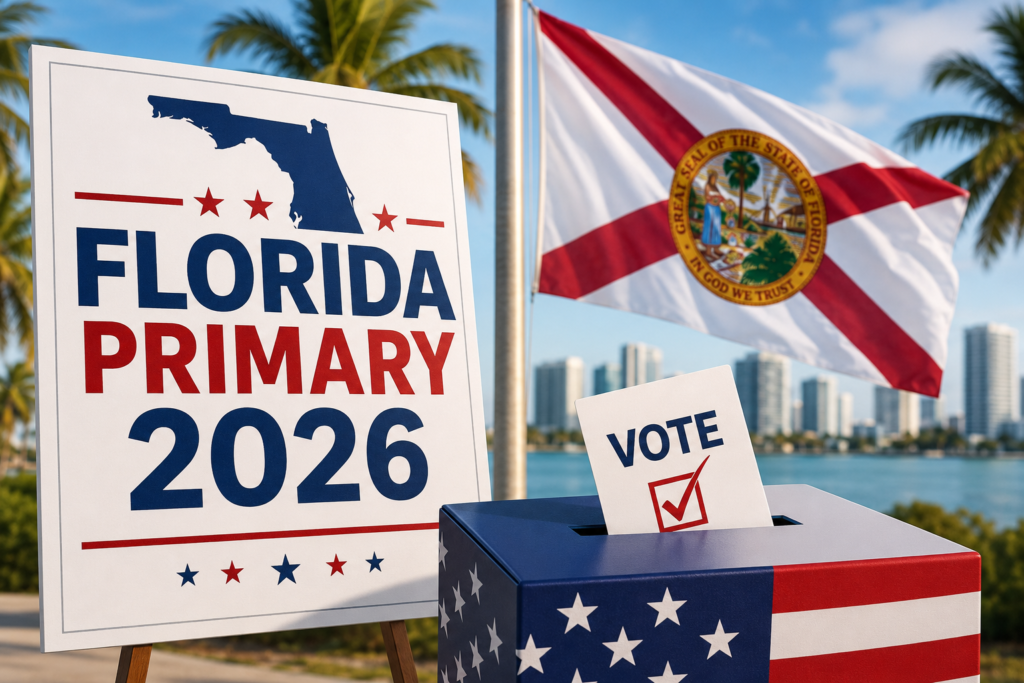
florida primary 2026
The Florida primary 2026 election is one of the most important political events of the year for voters across the Sunshine State. With major statewide offices, congressional seats, state legislative positions, and numerous local contests on the ballot, the primary plays an important role in deciding which candidates will move forward to the November general election.
Florida’s 2026 primary election is scheduled for August 18, 2026. The state’s official election calendar lists July 20 as the voter registration and party-affiliation deadline, August 6 as the deadline to request a vote-by-mail ballot, and August 8 through August 15 as the mandatory early-voting period.
For anyone searching for information about the Florida primary 2026, understanding the rules is just as important as knowing the candidates. Florida operates primarily as a closed-primary state, meaning a voter’s registered party can determine which partisan Florida primary 2026 contests appear on their ballot. There are also exceptions for certain races and nonpartisan contests.
This guide explains the Florida primary 2026 election in straightforward language. It covers important dates, voting rules, major offices, party registration, early voting, vote-by-mail, and what happens after the primary.
What Is the Florida Primary 2026 Election?
The Florida primary 2026 is the election used to select party nominees who may advance to the general election. In a typical partisan contest, voters choose among candidates competing for their party’s nomination. The winners can then face candidates from other parties in November.
The Florida primary 2026 is particularly significant because several major statewide offices are on the election calendar. According to the Florida Division of Elections, voters will encounter contests involving the U.S. Senate, all U.S. House districts, governor and lieutenant governor, attorney general, chief financial officer, commissioner of agriculture, and various state legislative offices.
The Florida primary 2026 also reaches beyond statewide politics. Depending on the county and district, voters may see races for county commissioners, school board seats, judicial positions, state attorneys, public defenders, and special districts. That means the ballot can look very different from one Florida county to another.
For voters, the most important takeaway is simple: the Florida primary 2026 is not just about high-profile statewide candidates. Local races can have a direct impact on schools, public services, courts, transportation, taxes, and community development. Checking the actual ballot for your county is therefore essential.
When Is the Florida Primary 2026?
The official Florida primary 2026 election day is Tuesday, August 18, 2026. The Florida Department of State has published the date as part of its official 2026 election calendar.
Several important deadlines come before election day. The voter registration and party-affiliation deadline was July 20, 2026. Voters who wanted to request a vote-by-mail ballot for the Florida primary 2026 had until August 6, while the mandatory statewide early-voting period ran from August 8 through August 15. Counties can also offer additional early-voting days within the legal framework.
The timing matters because missing one deadline does not necessarily mean the same thing as missing another. For example, a voter who is already registered but wants to change party affiliation generally must do so by the registration deadline for a closed partisan primary. Meanwhile, vote-by-mail has its own request deadline.
The general election follows later in the year. Florida’s 2026 general election is scheduled for November 3, 2026, with the mandatory early-voting period scheduled for October 24 through October 31.
Is Florida a Closed Primary State?
Yes. Florida is generally a closed primary state. This is one of the most important rules to understand before voting in the Florida primary 2026.
In a closed primary, voters normally must be registered with the political party holding the priFlorida primary 2026 mary to vote for that party’s candidates. Florida’s Department of State specifically describes the state as a closed-primary state.
For example, a voter registered as a Republican generally participates in Republican partisan Florida primary 2026 contests, while a voter registered as a Democrat generally participates in Democratic partisan contests. A voter registered without party affiliation normally cannot simply choose either major-party primary ballot.
However, Florida’s rules include important exceptions. Certain races can be open to all registered voters when candidates have the same party affiliation and the winner will not face opposition in the general election. Nonpartisan contests, including certain judicial and school board races, can also appear on ballots regardless of party affiliation.
Because these rules can vary by race, voters should not assume that every contest on the primary ballot follows exactly the same format. Checking your official sample ballot before voting can prevent confusion.
Which Major Offices Are on the Florida 2026 Ballot?
The Florida 2026 election cycle includes a broad range of offices. At the federal level, voters will select candidates for one U.S. Senate seat and all Florida seats in the U.S. House of Representatives.
At the state level, the ballot includes the offices of governor and lieutenant governor, attorney general, chief financial officer, and commissioner of agriculture. State Senate seats in even-numbered districts and all state House districts are also included in the 2026 election cycle.
These statewide offices are especially important because they influence Florida policy for years. The governor has a major role in the state’s executive branch, while the cabinet offices oversee areas such as legal affairs, state finances, and agriculture.
Local offices add another layer. Depending on where a voter lives, the ballot may include county commissioners, school board members, judges, and special-district representatives. The Florida Department of State notes that county offices can vary by county, so there is no single statewide ballot that every Floridian will see.
Who Can Vote in the Florida Primary 2026?
Eligibility to vote depends on Florida’s voter-registration requirements. Eligible residents must be properly registered before the applicable deadline, and their registration information should be current.
For the 2026 primary, Florida’s voter-registration deadline was July 20, 2026. The same date was also the deadline for changing party affiliation for purposes of the August primary.
This deadline is particularly important because changing party registration shortly before election day does not necessarily allow a voter to participate in a different party’s primary. Florida’s closed-primary structure makes party affiliation a practical part of election preparation.
Voters can also check their registration information through the state’s election resources. The Florida Division of Elections provides voter information, registration resources, precinct information, election dates, and vote-by-mail services through its official election website.
How Does Early Voting Work in Florida in 2026?
Early voting gives Florida voters an alternative to showing up on primary election day. For the 2026 primary, the mandatory early-voting period is August 8 through August 15. Counties may also offer optional additional days within the permitted schedule.
Early voting can be useful for people who have work commitments, travel plans, family responsibilities, or simply prefer to avoid election-day crowds. Instead of waiting until August 18, voters can visit an authorized early-voting location during the applicable hours.
One useful feature of Florida’s election system is that secure ballot intake stations can be available at designated early-voting sites. These stations allow voters who are returning vote-by-mail ballots to submit them securely during authorized hours. The state says these locations are monitored by election officials.
Because locations and hours can vary by county, voters should check their county Supervisor of Elections before heading out. A location that was available in a previous election may not necessarily be the same location used for the 2026 primary.
How Does Vote-by-Mail Work for the Florida Primary?
Florida voters can use vote-by-mail, but a request must be made through the appropriate county Supervisor of Elections. The state explains that vote-by-mail requests are handled by the Supervisor of Elections in the county where the voter is registered.
For the 2026 primary, the deadline to request that a ballot be mailed was August 6, 2026. This deadline is different from the voter-registration deadline, which was July 20.
That distinction is worth remembering. Registering to vote and requesting a vote-by-mail ballot are two separate steps. A voter cannot assume that being registered automatically means a ballot will arrive by mail.
Military and overseas voters can have different vote-by-mail procedures and deadlines. Florida’s election calendar includes separate deadlines for UOCAVA voters, reflecting the additional time required for ballots traveling to voters outside the state or country.
Why Party Affiliation Matters in Florida Primary Elections
Party affiliation has a bigger role in Florida than many voters realize. Because Florida generally uses closed primaries, the party listed on a voter’s registration can determine which partisan primary contests that voter is eligible to participate in.
Florida’s two major political parties are the Republican Party of Florida and the Florida Democratic Party. The state also recognizes several minor political parties, while voters can register without party affiliation.
This does not mean voters are locked permanently into one political identity. Voters can change their registration, but the change must be made before the relevant registration deadline if they want it to apply to a particular primary.
For the 2026 primary, that deadline was July 20. Anyone researching the Florida primary 2026 after that date should understand that changing registration after the deadline may not affect eligibility for the August 18 primary.
Florida Primary 2026 and the Governor’s Race
The governor’s race is one of the most closely watched contests in Florida politics during the 2026 election cycle. The governor is elected every four years, and the office is among those scheduled for election in 2026.
A primary can be particularly important in a governor’s race because it can determine which candidates receive their party’s nomination. The primary stage can also shape the issues that dominate the November campaign.
Florida’s governor has broad responsibilities involving the executive branch, state agencies, appointments, legislation, emergency powers, and the overall direction of state government. As a result, the gubernatorial contest can influence policy well beyond Tallahassee.
Voters interested in the governor’s race should look beyond campaign advertisements and social media posts. Comparing candidate platforms, experience, voting records where applicable, policy proposals, and campaign disclosures can provide a more complete picture.
Florida Primary 2026 and Congressional Races
Congressional contests are another major part of the 2026 Florida election. The state will elect candidates for all of its U.S. House districts, while one U.S. Senate seat is also scheduled for election.
Congressional elections matter because federal lawmakers influence issues ranging from taxation and immigration to healthcare, infrastructure, national security, education funding, and economic policy.
The primary stage can be decisive in districts where one political party is strongly favored in the general election. In such areas, the primary winner may have a significant advantage heading into November.
However, voters should remember that district boundaries and candidate fields can change the political landscape from one area to another. The most reliable approach is to check the official candidate and race information for the voter’s specific district rather than relying on statewide headlines.
How to Prepare for the Florida Primary 2026
Good election preparation does not have to be complicated. Start by checking your voter registration and confirming your current address and party affiliation. This is especially important for anyone who has moved, changed their name, or wants to participate in a particular party’s primary.
Next, look at the sample ballot for your county. The ballot tells you which races you will actually be voting on. It can also include local contests that receive far less media attention than statewide races.
Research candidates using reliable sources and compare their positions on issues that matter to you. Campaign websites can provide useful information, but voters may also want to examine official election records, public statements, debates, and other independent sources.
Finally, decide how and when you will vote. Whether you choose early voting, vote-by-mail, or election-day voting, knowing your plan ahead of time makes the process much easier.
What Happens After the Florida Primary?
Once the primary election is completed, the candidates who win their respective contests can move forward to the general election when the race requires it. The general election is scheduled for November 3, 2026.
The period between the primary and general election can become highly active. Candidates usually expand their campaigns, raise additional funds, increase advertising, and focus on persuading voters who may not have participated in the primary.
For voters, the November ballot can look different from the August ballot. Some primary contests may have been decided, while other races can feature candidates from different political parties competing against each other.
It is also important to remember that winning a primary does not automatically mean winning the office. The general election determines who ultimately takes the position when the contest proceeds to November.
Why the Florida Primary 2026 Matters
The Florida primary 2026 matters because primary elections often determine which choices voters will have in November. In some districts, the primary can be the most competitive stage of the entire election.
The election also provides voters with an opportunity to influence the direction of state and local government. Decisions made by elected officials can affect everyday matters such as schools, transportation, public safety, taxes, housing, environmental policy, and economic development.
Another reason the primary matters is turnout. Primary elections often attract fewer voters than general elections, which means the people who participate can have a disproportionately large influence over candidate selection.
Ultimately, voting is not only about major national headlines. Local and state elections can have a surprisingly direct effect on everyday life. That makes understanding the Florida primary 2026 an important step for anyone eligible to participate.
Florida Primary 2026: Key Dates at a Glance
| Election Event | 2026 Date |
|---|---|
| Voter registration deadline | July 20, 2026 |
| Party-affiliation change deadline | July 20, 2026 |
| Vote-by-mail request deadline | August 6, 2026 |
| Mandatory early voting | August 8–15, 2026 |
| Florida Primary Election Day | August 18, 2026 |
| General Election | November 3, 2026 |
These dates come from the Florida Division of Elections’ 2026 election calendar.
Final Thoughts on the Florida Primary 2026
The Florida primary 2026 is a major part of the state’s election cycle, with important contests at the federal, state, county, and local levels. The primary is scheduled for August 18, with early voting taking place before election day and separate deadlines applying to voter registration and vote-by-mail requests.
The most important thing for voters is to understand Florida’s closed-primary system. Party affiliation can determine which partisan contests appear on a voter’s ballot, while certain nonpartisan and qualifying open-primary situations follow different rules.
Voters should also remember that election information can be specific to a county or district. Candidate lists, polling locations, sample ballots, and local contests should therefore be verified through official election resources rather than relying entirely on social media or old election information.
With the primary leading into the November 3 general election, Florida voters have an important opportunity to shape the state’s political direction. Checking registration, researching candidates, understanding the ballot, and making a voting plan are simple steps that can make the entire process smoother and more informed.
YOU MAY ALSO READ

wellcome to glamnetworth i am rimsha razzaq and AI-Powered SEO , and containt writer with four years of experince i help website rank higher, grow traffic, and look amazing . my goal is to make SEO and web design simple and effective for everyone . Lets achieve more together|