
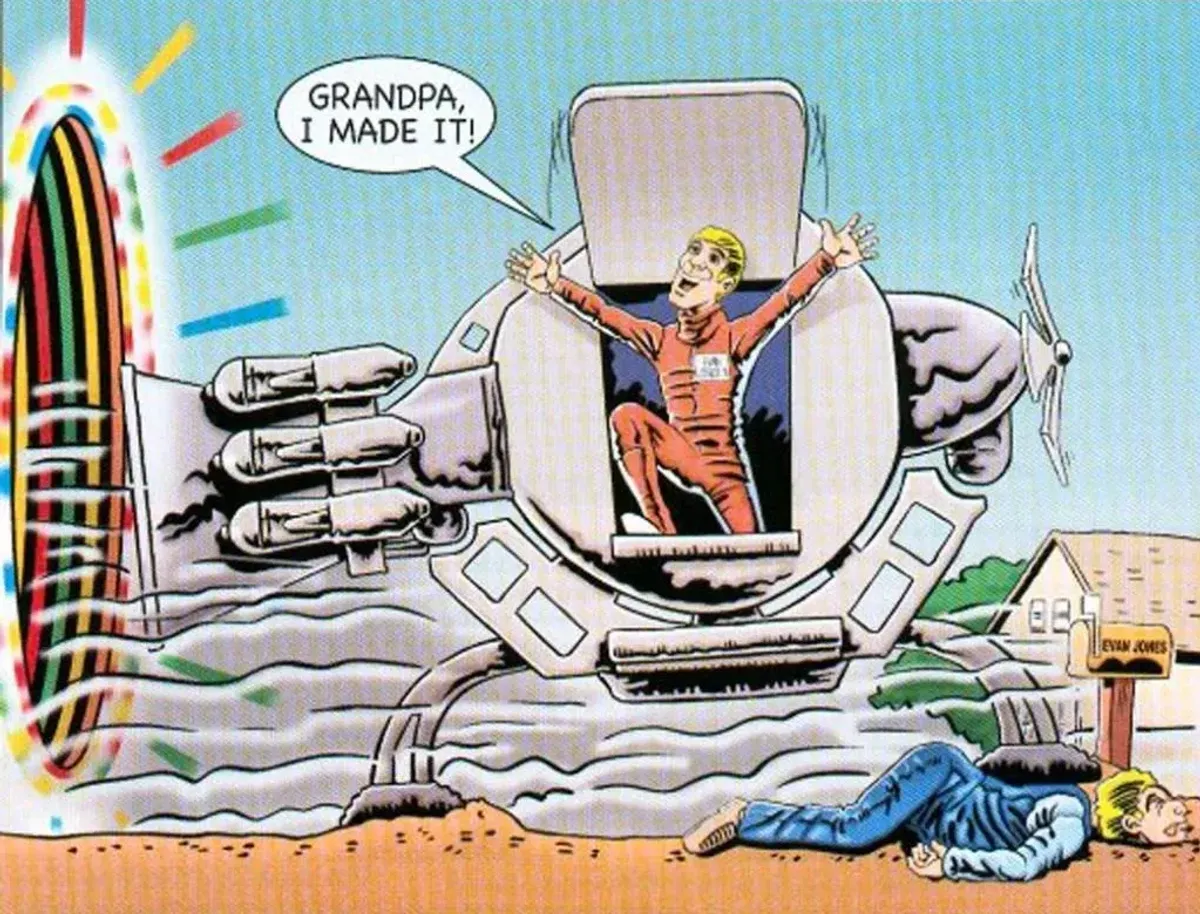
Grandfather Paradox Time travel has fascinated people for centuries. From science fiction novels and blockbuster movies to serious discussions among physicists, the idea of traveling through time continues to capture human imagination. One concept that appears in almost every discussion about time travel is the grandfather paradox. It is one of the most famous thought experiments in philosophy and theoretical physics because it challenges our understanding of cause and effect.
The grandfather paradox asks a surprisingly simple question with an incredibly complicated answer. What would happen if you traveled back in time and prevented your grandfather from meeting your grandmother before your parent was born? If your parent was never born, then you would never exist. But if you never existed, who traveled back in time to stop the meeting in the first place?
Although this sounds like a fictional puzzle, scientists and philosophers have spent decades debating whether such a situation could ever happen. The discussion has led to fascinating theories about alternate timelines, parallel universes, and the laws of physics. Whether time travel ever becomes possible or not, the grandfather paradox remains one of the greatest intellectual challenges in modern science.
What Is the Grandfather Paradox?
The grandfather paradox is a logical contradiction that arises when someone travels into the past and changes an event that is essential to their own existence. It was created as a thought experiment rather than a real scientific experiment, but it continues to influence discussions about time travel.
Imagine inventing a time machine. You travel back to the year before your grandfather met your grandmother. If you somehow prevented their relationship from ever happening, one of your parents would never be born. Without your parent, you would also never exist. This creates an impossible loop because the person who changed history would disappear before making the trip.
The paradox highlights a conflict between free will and causality. Every event has a cause, and changing a crucial event may erase the very cause that allowed the change to happen. This contradiction is why the grandfather paradox has become one of the most discussed concepts in theoretical physics and philosophy.
The Origin of the Grandfather Paradox
Although people have imagined time travel for centuries, the grandfather paradox became popular during the twentieth century when writers and scientists began exploring the consequences of altering history.
Science fiction authors introduced similar ideas long before physicists seriously discussed them. Stories involving changing the past often led to unexpected consequences, inspiring readers to think about how fragile history might actually be. These fictional works helped make the paradox widely recognized.
Later, philosophers and physicists adopted the concept as a serious intellectual problem. Instead of focusing on entertainment, they examined whether the laws of nature would even allow such contradictions. Today, the grandfather paradox is used in classrooms, scientific papers, and philosophical debates to explain why time travel is far more complicated than it first appears.
Why the Grandfather Paradox Is So Important
The grandfather paradox matters because it exposes a fundamental problem with backward time travel. It forces us to ask whether the universe allows events that contradict themselves.
Modern physics depends heavily on causality, the principle that causes always come before effects. If someone could erase the cause of their own existence, this rule would break down completely. That would create logical inconsistencies that challenge the foundations of science.
The paradox also raises important philosophical questions. Does the future already exist? Can people truly change destiny? Is every decision fixed, or do we have unlimited freedom? These questions extend beyond physics and touch psychology, ethics, and even theology.
Finally, the grandfather paradox reminds us that even if engineers someday build a time machine, understanding its consequences may be much harder than building the machine itself.
Scientific Theories That Try to Solve the Grandfather Paradox
Scientists have proposed several fascinating ideas that could prevent the grandfather paradox from ever occurring.
One popular explanation is the Novikov Self-Consistency Principle. This theory suggests that history cannot be changed. Even if you traveled to the past intending to alter an important event, something would always prevent you from succeeding. Your actions would already be part of history rather than changing it.
Another possibility involves parallel universes. According to this theory, traveling into the past creates an entirely new timeline instead of changing your original one. If you prevented your grandparents from meeting, you would only affect the new universe while your original timeline would remain unchanged.
Some physicists also believe backward time travel may simply be impossible. While Einstein’s theory of relativity allows certain mathematical possibilities, there is still no experimental evidence proving humans can travel into the past. If backward time travel cannot happen, the grandfather paradox disappears entirely.
The Grandfather Paradox in Popular Culture
The grandfather paradox has become a favorite theme in movies, television shows, novels, and video games because it creates suspense and endless storytelling possibilities.
Films often explore characters accidentally changing history and struggling to repair the timeline before disastrous consequences occur. These stories entertain audiences while introducing surprisingly complex scientific ideas in an accessible way.
Television series frequently use alternate timelines, looping events, and changing memories to illustrate different versions of the grandfather paradox. Each variation encourages viewers to think about how one small action could dramatically reshape the future.
Video games also embrace the concept. Players often make choices that alter historical events, leading to multiple endings. Although these scenarios are fictional, they demonstrate why the paradox remains one of the most exciting ideas in science fiction.
Could the Grandfather Paradox Actually Happen?
At the moment, nobody knows whether the grandfather paradox could ever occur because no one has successfully traveled backward through time.
Einstein’s General Theory of Relativity allows mathematical solutions that involve unusual space-time structures such as wormholes. However, these solutions require conditions that may never exist naturally or be achievable through technology.
Quantum mechanics adds another layer of complexity. Some interpretations suggest multiple realities could exist simultaneously, reducing the contradiction by separating different timelines rather than rewriting history.
Despite decades of research, no scientific experiment has confirmed that traveling into the past is possible. Until stronger evidence emerges, the grandfather paradox remains an intriguing theoretical problem rather than a practical one.
Philosophical Lessons from the Grandfather Paradox
The grandfather paradox is valuable because it teaches us to think critically about logic, identity, and the nature of reality.
It encourages us to question whether our choices truly shape the future or whether every event is already determined. Philosophers have debated these issues for centuries, and the paradox offers a fresh perspective on old questions.
The thought experiment also demonstrates the importance of consistency in reasoning. A single contradiction can undermine an entire logical system, making the paradox a useful educational tool for students of philosophy and mathematics.
Most importantly, the grandfather paradox reminds us that the universe may operate according to rules far stranger than everyday experience suggests. Even impossible-seeming questions can inspire meaningful scientific discoveries.
The Future of Time Travel Research
Research into time travel continues even though practical applications remain far beyond current technology. Physicists study black holes, wormholes, quantum gravity, and space-time geometry to better understand whether time travel could theoretically exist.
Advances in quantum physics have introduced new ways of thinking about causality and information. While these discoveries do not prove that backward time travel is possible, they keep the conversation alive and inspire new research.
Future breakthroughs in physics may eventually provide answers that today’s scientists cannot yet imagine. Until then, the grandfather paradox will continue to challenge researchers and inspire creative thinkers around the world.
Conclusion
The grandfather paradox is much more than an entertaining science fiction idea. It is a powerful thought experiment that explores the limits of logic, causality, and our understanding of time itself. By asking what would happen if someone changed the past, the paradox forces scientists and philosophers to confront some of the deepest questions about reality.
Although no one has demonstrated that backward time travel is possible, the theories developed to explain the grandfather paradox have expanded our understanding of physics and inspired countless discussions about alternate universes, deterministic timelines, and the structure of space-time. These ideas continue to influence both academic research and popular culture.
Whether time machines remain forever fictional or become reality in the distant future, the grandfather paradox will remain one of humanity’s most fascinating intellectual puzzles. It challenges us to think beyond ordinary experience and reminds us that the universe may be far more mysterious than we currently understand.
Frequently Asked Questions (FAQs)
What is the grandfather paradox?
The grandfather paradox is a thought experiment in which a time traveler changes the past in a way that prevents their own birth, creating a logical contradiction.
Is the grandfather paradox scientifically possible?
There is currently no scientific evidence that backward time travel is possible, so the paradox remains theoretical.
How do scientists explain the grandfather paradox?
Proposed explanations include the Novikov Self-Consistency Principle, parallel universe theories, and the idea that changing the past may simply be impossible.
Why is the grandfather paradox famous?
It is famous because it clearly demonstrates the logical problems associated with changing past events through time travel.
Does the grandfather paradox prove time travel is impossible?
No. It highlights challenges that any theory of backward time travel must solve, but it does not definitively prove that time travel cannot exist.

wellcome to glamnetworth i am rimsha razzaq and AI-Powered SEO , and containt writer with four years of experince i help website rank higher, grow traffic, and look amazing . my goal is to make SEO and web design simple and effective for everyone . Lets achieve more together|