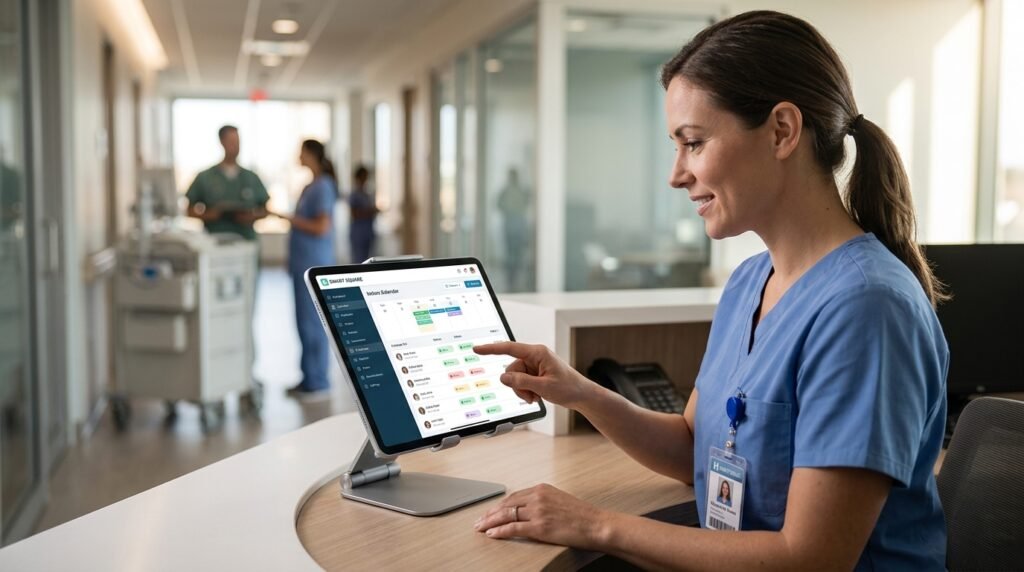
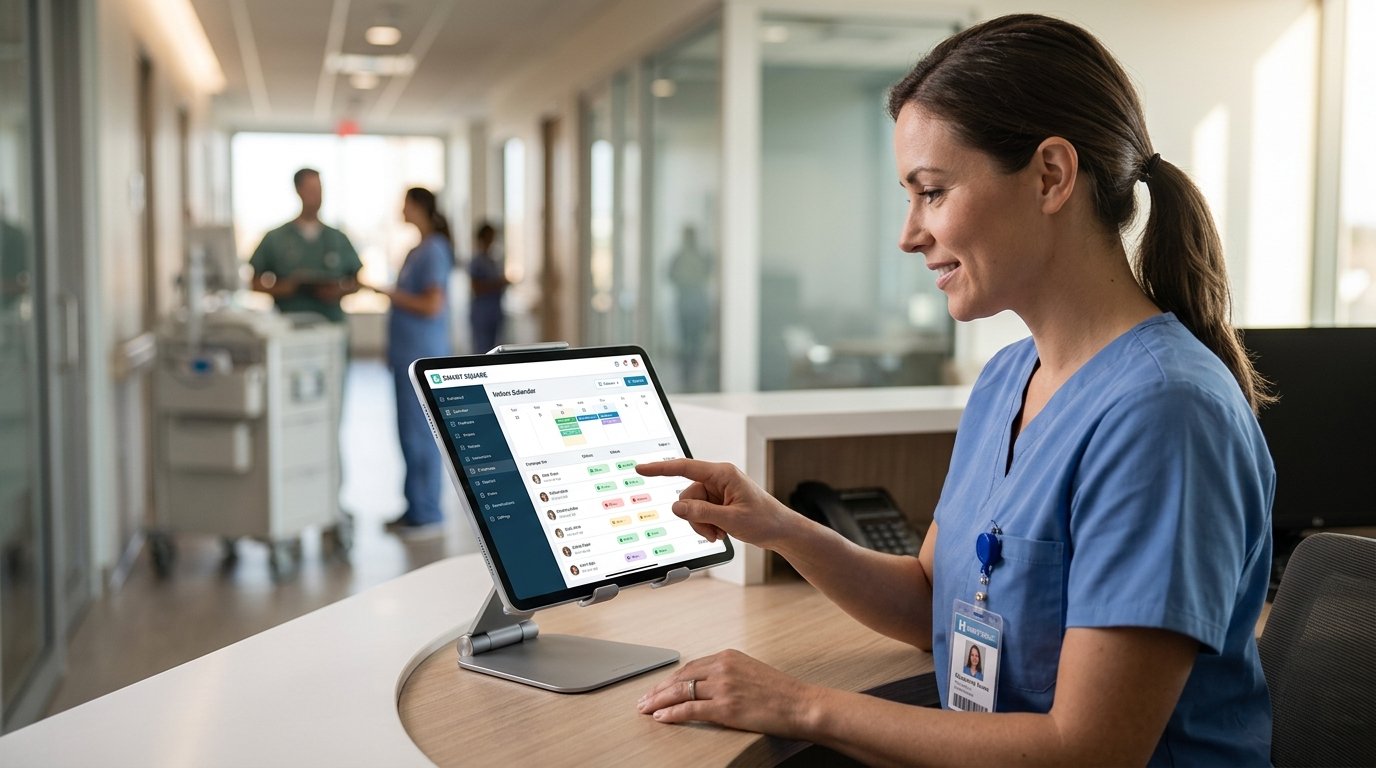

HMH Smart Square Healthcare organizations deal with a scheduling challenge that is far more complicated than putting names on a calendar. Nurses work different shifts, patient demand changes throughout the day, departments have different staffing requirements, and unexpected absences can quickly create coverage problems. This is where HMH Smart Square becomes important.
HMH Smart Square refers to the Smart Square scheduling environment used in connection with Hackensack Meridian Health (HMH). Smart Square is healthcare workforce scheduling software designed to help organizations plan staffing, manage shifts, improve visibility, and respond to changing workforce needs. The platform is now part of symplr, which acquired Smart Square from AMN Healthcare in July 2025.
For HMH employees and managers, the system can make everyday scheduling tasks considerably easier. Instead of relying entirely on spreadsheets, phone calls, emails, or manually updated schedules, healthcare teams can use a centralized digital system to manage workforce information.
What Is HMH Smart Square?
HMH Smart Square is essentially a healthcare workforce scheduling and management solution associated with Hackensack Meridian Health. Its purpose is to help healthcare teams coordinate employees and shifts while considering staffing requirements, employee availability, and operational demands.
Unlike a basic calendar application, healthcare scheduling software has to deal with much greater complexity. A hospital may need nurses with specific competencies, different staffing ratios, rotating shifts, weekends, holidays, on-call coverage, and sudden changes in patient volume. Smart Square is designed around these kinds of healthcare-specific scheduling challenges.
The broader Smart Square platform provides predictive scheduling, open-shift management, self-scheduling, staffing visibility, and analytics. According to symplr, its current platform can forecast staffing requirements up to 120 days in advance and use predictive analytics to help organizations prepare for future demand.
Why HMH Needs a Smart Scheduling System
Managing a large healthcare workforce manually can become overwhelming very quickly. Even a small scheduling mistake can affect multiple employees and departments. If a staff member calls out unexpectedly, a manager may need to find a replacement while making sure the replacement has the correct qualifications.
This becomes even more complicated across a large healthcare network. Managers need to understand where staffing shortages exist, which employees are available, and whether available workers can safely fill particular roles.
A centralized scheduling platform gives managers a clearer picture. Rather than depending on scattered information, they can work from scheduling data in one environment. Smart Square is designed to provide that kind of visibility and help healthcare leaders make more informed workforce decisions.
How Smart Square Helps Healthcare Staff
For healthcare employees, scheduling tools are not simply about convenience. A clear schedule can make it easier to organize family responsibilities, transportation, personal appointments, and other commitments.
Smart Square includes self-scheduling capabilities that give eligible staff greater flexibility when selecting shifts. The exact options available can depend on an organization’s configuration and workforce policies, but the overall goal is to give employees more visibility and control.
The platform also supports open-shift management. When shifts become available, healthcare organizations can use digital workflows to communicate those opportunities instead of relying entirely on manual calls or messages. This can make the process faster and more transparent.
HMH Smart Square Login and Access
One of the most common reasons people search for HMH Smart Square is to find the correct login process. Employees should be careful when searching for login information because many third-party websites use similar names and may not be affiliated with Hackensack Meridian Health or symplr.
Search results currently commonly point users toward the HMH Smart Square environment at meridian.smart-square.com, with sources describing options such as continuing to Smart Square or using an alternate login. However, employees should always follow the login link and access instructions provided directly by HMH rather than entering credentials on an unfamiliar website.
If a login does not work, the problem may involve credentials, account permissions, network access, or an organization-specific authentication requirement. It is better to use HMH’s official internal support channels than to provide your username or password to an unofficial website.
Main Features of HMH Smart Square
Smart Square offers several features designed specifically for healthcare workforce management. One of the most important is predictive scheduling. Rather than waiting until a staffing shortage becomes obvious, the system can use forecasting to help managers anticipate future workforce requirements.
Open-shift management is another major feature. Healthcare organizations can publish available shifts and allow appropriate staff to respond according to configured rules. This can reduce the amount of manual coordination required by staffing offices.
The platform also provides enterprise staffing visibility. Managers can gain a broader view of staffing across departments and facilities, helping them identify potential gaps and make more informed deployment decisions. Smart Square also supports self-scheduling, cyclic scheduling, on-call scheduling, and competency-based staffing workflows.
Predictive Analytics and Smarter Staffing
One of the most interesting aspects of Smart Square is its use of predictive analytics. Traditional scheduling tends to be reactive. A manager notices that a department is short-staffed and then begins searching for a solution.
Predictive scheduling changes that approach. Instead of looking only at today’s staffing situation, the system can help organizations anticipate future demand. Symplr says Smart Square can forecast staffing needs up to 120 days ahead, giving healthcare leaders more time to prepare.
This does not mean that software replaces human judgment. Healthcare managers still understand the realities of their units, teams, patients, and organizational policies. Instead, predictive tools can provide additional information that helps managers make decisions earlier and with greater confidence.
How Smart Square Can Improve Staff Scheduling
A well-designed scheduling system can reduce unnecessary administrative work. Managers do not have to spend as much time searching through spreadsheets or manually comparing different staffing requirements.
Smart Square also helps make schedule information more visible. When staffing data, open shifts, and scheduling information are managed digitally, employees and managers can work from more current information.
Another advantage is flexibility. Healthcare staffing rarely stays exactly as planned. Employees become unavailable, patient volumes change, and unexpected situations occur. A system designed for dynamic scheduling can help organizations respond to those changes more efficiently.
HMH Smart Square and Employee Work-Life Balance
Healthcare professionals often work demanding schedules, including nights, weekends, holidays, and extended shifts. Having greater visibility into work schedules can make personal planning easier.
Self-scheduling is particularly useful because it can give eligible employees a role in building their schedules while still maintaining organizational coverage requirements. Symplr describes self-scheduling as a way to give healthcare workers more flexibility and predictability.
Better scheduling does not automatically eliminate workplace stress, of course. Staffing levels, workload, management practices, and many other factors influence employee well-being. Still, reducing avoidable scheduling confusion can remove one source of frustration from an already demanding profession.
Real-World Results at Hackensack Meridian Health
The connection between Smart Square and HMH Smart Square is more than theoretical. Symplr has published a case study describing Hackensack Meridian Health’s workforce-planning experience with Smart Square.
According to the case study, HMH faced outdated scheduling technology and challenges related to staffing processes and FTE leakage. The organization began using Smart Square in a phased approach, initially involving five hospitals, and later expanded its use during the COVID-19 pandemic.
The published results are particularly interesting. HMH reported a 6.5% reduction in FTE leakage compared with the previous year, representing approximately $616,000 in cost savings in the case study period. These figures come from symplr’s customer success story, so they should be understood as reported results from that specific HMH implementation rather than a guarantee for every organization.
Smart Square After the symplr Acquisition
An important development for anyone researching HMH Smart Square is the change in ownership. In July 2025, symplr announced that it had acquired Smart Square’s scheduling software from AMN Healthcare.
The acquisition brought Smart Square into symplr’s broader healthcare operations portfolio. Symplr describes Smart Square as a cloud-based workforce management solution with predictive analytics, real-time staffing adjustments, open-shift management, and nurse competency integration.
For users, this matters because Smart Square is continuing to evolve as part of a larger healthcare technology ecosystem. Symplr currently promotes integrations with HR, payroll, timekeeping, and EMR systems, creating opportunities for organizations to connect workforce information across different operational areas.
Is HMH Smart Square Useful for Managers?
For nurse managers, staffing leaders, and healthcare administrators, Smart Square can be particularly useful because scheduling decisions involve much more than employee availability.
Managers need to think about coverage, skills, workload, overtime, open positions, and future demand. Having centralized information can make these decisions easier to evaluate.
The analytics side is also valuable. Instead of looking at schedules only as individual shifts, managers can analyze broader workforce patterns. This can help identify recurring staffing gaps and support longer-term workforce planning. Smart Square’s current feature set is built around this combination of scheduling automation, predictive analytics, and operational visibility.
Common HMH Smart Square Problems
Even a sophisticated scheduling platform can sometimes present technical problems. A user may be unable to log in, see an outdated schedule, access a particular feature, or receive an expected notification.
Not every issue is caused by the Smart Square platform itself. Problems can also result from incorrect credentials, browser issues, authentication settings, account permissions, network restrictions, or temporary service problems.
The safest approach is to avoid unofficial troubleshooting websites that ask for sensitive credentials. If an HMH employee cannot access the system, they should use the organization’s approved IT or workforce-management support process. This is especially important because scheduling systems can contain sensitive employment and operational information.
HMH Smart Square and the Future of Healthcare Workforce Management
Healthcare workforce management is moving toward increasingly data-driven scheduling. Hospitals need to respond to changing patient demand while also managing labor costs and employee expectations.
Smart Square represents this broader shift from reactive scheduling toward predictive workforce planning. Its current platform combines forecasting, automation, open-shift management, self-scheduling, and enterprise staffing visibility.
The future will likely involve even deeper integration between workforce platforms and other healthcare systems. Artificial intelligence and predictive analytics may help managers identify staffing risks earlier, while employees may gain more flexible tools for managing their schedules.
Final Thoughts on HMH Smart Square
HMH Smart Square is more than a digital calendar. It is part of a healthcare workforce-management approach designed to make complicated scheduling more predictable, visible, and manageable.
For HMH employees, the system can provide easier access to schedules and scheduling workflows. For managers, it can provide broader staffing visibility and predictive information that supports workforce decisions. For healthcare organizations, the bigger goal is to align staffing with actual operational demand while reducing unnecessary administrative effort.
The platform has also continued to develop under symplr, which acquired Smart Square from AMN Healthcare in 2025. Symplr now positions Smart Square as a major component of its healthcare workforce-management technology, with predictive scheduling and AI-driven capabilities at the center of the product.
Ultimately, the value of HMH Smart Square comes down to how effectively technology supports the people using it. A scheduling platform cannot replace experienced healthcare managers or clinical judgment. What it can do is provide better information, automate repetitive processes, and help teams spend less time fighting scheduling problems and more time focusing on the work that matters.
YOU MAY ALSO READ

wellcome to glamnetworth i am rimsha razzaq and AI-Powered SEO , and containt writer with four years of experince i help website rank higher, grow traffic, and look amazing . my goal is to make SEO and web design simple and effective for everyone . Lets achieve more together|